Why route optimisation projects succeed
The route optimisation projects that work don’t have better solvers than the ones that don’t. The solvers are broadly the same. What separates them shows up in the first three weeks after go-live, in how the team reads the dispatchers.
Every project has the same early moment. The pilot came back with routes eight percent cheaper than what actually ran, the number was real, everyone agreed it was worth doing — and then the plan meets the depot, and the dispatchers start overriding it.
The projects that fail read the overrides as resistance and train harder. The projects that succeed read them as information.
The override is the data
The dispatcher who ignores your sequence usually knows something the model doesn’t.
- The dock at a particular customer is unusable before ten, whatever the contract says.
- One driver can do the old city route in half the time anyone else can, and nobody wrote that down.
- The third drop needs a two-man lift, and the model thinks a vehicle is a vehicle.
None of this is in the data. All of it is in someone’s head. When the plan violates it, the override isn’t sabotage — it’s a correction.
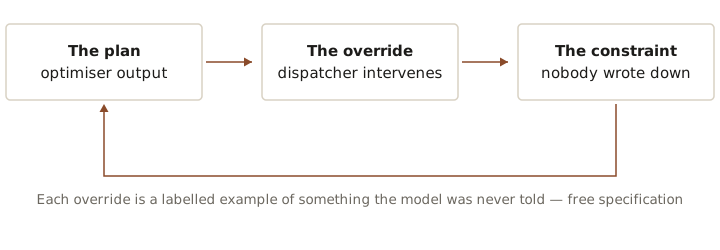
So the teams that get somewhere instrument the overrides before trying to eliminate them. Every manual change to a generated route is a labelled example of a missing constraint, and a month of those is a better specification than any requirements workshop will produce. The override rate falls on its own once the model stops being wrong — which is a much easier thing to achieve than persuading people to follow a plan they can see is wrong.
The useful question after a pilot isn’t “how much did we save?” It’s “which constraints did we discover we hadn’t written down?”
Scope against a number someone owns
The second thing the successful ones do is earlier, and quieter.
If a pilot’s success criterion is a model metric — accuracy, percentage improvement over baseline — there is usually nobody on the other side waiting for the result. The projects that survive contact with a budget are scoped against an operational number someone is already accountable for, and they can name the person.
That has a practical test you can run in week one. If this works, whose budget does it come out of next year, and what on their scorecard moves? A project that can answer that will find an owner when the pilot ends. A project that can’t will produce a good deck and stop.
Don’t announce the eight percent
The last difference is patience with the headline. Announcing the pilot’s saving at the first steering committee converts a discovery phase into a promise, and the rest of the year gets spent explaining why the promise hasn’t materialised in the P&L — where fuel moved, volume mix changed, and two customers churned.
The projects that work treat the first quarter as constraint discovery, tell the steering committee exactly that, and only start counting savings once the overrides have stopped telling them something new. They report later and they report numbers that survive a finance review.
None of this is about the optimiser. The optimiser was never the hard part.