Why does Nike keep getting technology right?
A case study of Nike Run Club
In March 2018, I hit a weight of 90 kilos at 5 foot 8 inches tall and 36 years old. A playful game with the new weighing machine while my relatives were visiting, became a wake up call for me: I wasn’t as healthy as I thought! I never thought of myself as an athlete, but I always felt I was “above average”. The reality of my overweight self, connected the dots for me on how climbing stairs had become especially harder in the recent weeks and months. A fun activity with my relatives forced me to think deeply about my weight and my health. In less than a week, I had signed up with a coach to help me lose weight.
Soon I did what any techie would do as the first step to lose weight - buy a smart watch!
I searched the internet for the most suitable smart watches. Given I was already an iPhone user, the Apple Watch was the first flag of convenience. I found out that the Apple Watch Nike+ was their top of the line watch product at that time. This was well before the days of Apple Watch Ultra. But given it was the more expensive version for a newbie health enthusiast and a consumer technology laggard like me, I settled for the other version and moved on.
The next decision was to pick an activity app to track workouts and runs. The free tier of Strava was an easy choice. My coach recommended it. Strava is a dedicated sports apps company that caters to fitness enthusiasts to track fitness activities. With a stronger focus on running, cycling and hiking, they built a strong following among serious health enthusiasts and athletes. The app gave me the choice to upgrade to a paid version later. After several weeks of using Strava, my brother, who is an avid runner himself, suggested I use the Nike Run Club App instead. He said he was using it, because it had running programs to develop aerobic capability and increase running mileage. He was surprised I wasn’t using it already. All his running friends used it.
Wait, what?!
Nike had a running app too? With running programs designed for newbie running just developing the habit. As opposed to Strava that started you off with a free tier with more advanced features unlocked after you upgrade to the paid version, the Nike Run App was free forever.
It looked like Nike had several digital products. I simply wasn’t aware. The technologist in me was intrigued.
That’s when I discovered Nike and Apple had announced partnership since 2006. By any estimate they possibly started working together at least months if not years before. Just to be clear, 2006 was one year BEFORE the launch of the first iPhone. Ten years later, they strengthened the partnership by announcing Apple Watch Nike+. Turns out Nike had already launched a digital activity tracker named Nike Fuel Band in 2012. A good four years before Apple launched their watch!
The partnership made sense for Apple. Apple had just launched its first Apple Watch in 2015. Fitness enthusiasts would be a natural fit for their market, given watches were able to track movement and some health parameters. “But what’s in it for Nike?” I remember thinking.
Nike was not just following Apple into the digital fitness devices market revolution, they were ahead of them! Everyone knows that Apple is famously late to the market unless they feel they have a product that they can bet on to dominate the category. But Nike was not a digital devices manufacturer. It is a sports apparel company. An apparel retailer surging ahead of Apple into fitness devices was quite a feat.
Nike was not behind in the fitness apps either: standing toe to toe with Strava, their closest competitor in the category, in terms of popularity. Nike Run Club continues to be a very successful fitness app. The table below shows the comparison in numbers.
| Android Play Store | Apple App Store | |||
|---|---|---|---|---|
| NRC | Strava | NRC | Strava | |
| Downloads | 50M+ | 50M+ | ||
| Ratings | 1.09M | 0.95M | 400k+ | 319k+ |
| Started | 2010 | 2012 | 2009 | 2009 |
Nike’s mobile app ecosystem
Furthermore, Nike also has many more apps on the Appstore than Strava. Nike Training Club, is an app for people training indoors and Nike Studios, lets book slots in one of many Nike affiliated fitness studios. Nike App lets consumers make purchases directly from the digital storefront without going to a retailer.
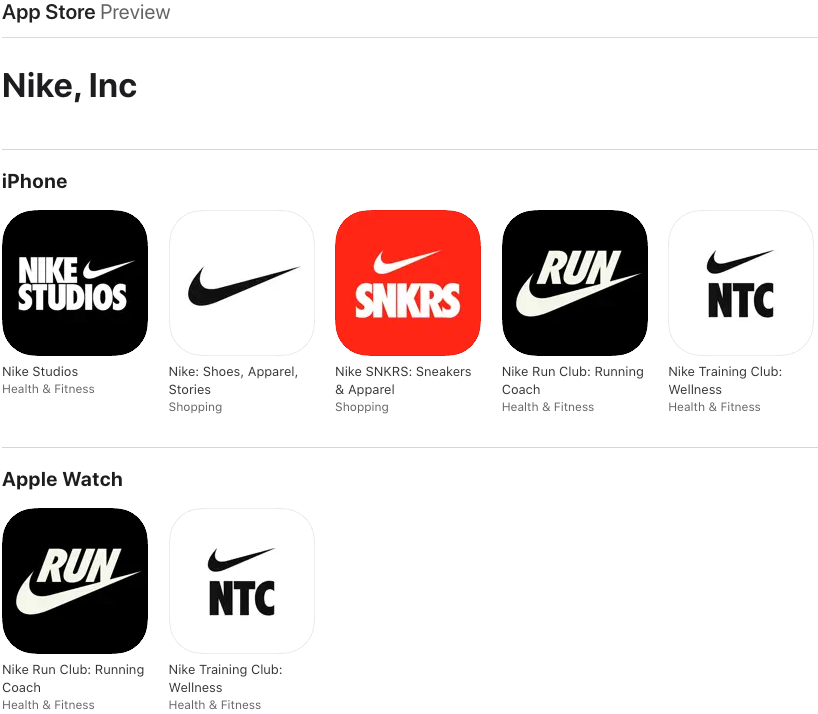
What amazes me is how an apparel retailer has become a fitness apps company, a devices company, and a gym network to name a few. And dominate so many segments at once.
More digital initiatives
As time has passed, I came to discover more and more of Nike’s digital initiatives. Many of them are Mobile Apps for greater customer experience, D2C, traditional retail, supply chain innovation, product development. Here is a short overview of all other digital initiatives Nike has undertaken in the last decade or so.
| Customer Experience | A set of Mobile Apps and fitness devices targeted towards increasing customer engagement, loyalty. Also creating an opportunity to increase customer touch points, study consumer behavior, and collect feedback. |
| Direct to Consumer | A thematic drive to create and drive company wide initiatives to sell directly to customers, reducing the dependency on traditional retail channels. |
| Retail Experience | The House of Innovation is Nike’s ultra-premium, digitally empowered flagship store concept, blending innovation, personalization, and community engagement across major cities like New York, Shanghai, and Paris |
| Supply Chain Digitisation | Nike integrated supply-chain-wide data and analytics to enhance inventory visibility, streamline logistics, and improve responsiveness. |
| Product Development | Nike React is a proprietary foam cushioning technology developed by Nike to deliver a combination of lightweight comfort, energy return, and durability in athletic footwear. |
With such a wide variety of digital and technological company wide initiatives, Nike time and again picks the right futuristic technologies to invest in. Not only that, Nike also continues to succeed in adoption of emerging technologies and technological trends to strengthen its position in the market. Therefore, it would surely be worthwhile to investigate what makes Nike consistently successful in adopting new tech and driving organizational success through them. The case in point and the links following provide sufficient context for researching and understanding more about Nike’s hugely successful track record.
Questions for discussion
After establishing that Nike is at the forefront of using emerging technologies to further its organizational goals, the following can be used to fuel an interactive classroom discussion. Participants are encouraged to ponder and research on the following topics so an interactive and substantial discussion can be had.
What is the rationale and the thought process behind Nike’s Consumer Digital Strategy? Why do they do what they do? What are the advantages of pursuing such a digital strategy? What advantages does the company gain over their competitors with such a strategy?
What are some of the drawbacks of such a strategy? What are the risks that such a company has to be willing to take? What are some of the possible failures?
What are the roadblocks you foresee in your organizations to pursue such digital transformation strategies? Are these roadblocks structural, cultural, processes, leadership?
What is the organizational structure that allows Nike to pursue such digital strategies? What is unique about Nike that is (maybe) missing in other companies?
What are the cultural aspects of the organization that enables Nike to continuously innovate and succeed at innovating?
What are some of the examples of such a strategy that you have seen in companies around you?