What is product strategy?
Article explains what product strategy actually means for an early stage software startup. Using examples of Airbnb and Uber article shows how one can think through their product’s strategy. While the article is written for the software industry, the underlying concepts can be applied to other industries as well.
The question: “what is your strategy?” has no meaning without a specific objective: “What is your strategy to win tomorrow’s match” makes more sense, for example.
Strategy is intrinsically hard to communicate. One because it often means different things to different people. Two because strategy is not just a plan. But it’s the “understanding” underlying the plan; the understanding that created the plan. These things make it difficult to benchmark one’s strategy leaving room for doubt and rework.
Here I’ll talk about how you can develop a solid understanding of your product’s strategy. You’ll be able to defend your strategy in your board room, in front of customers and investors. It will also give you the tools to prioritise requirements and roadmap your product with confidence.
Like any strategy, product strategy needs to start with a clear measurable objective: a Value Proposition. A value proposition is the ground on which other pillars of product strategy stand.
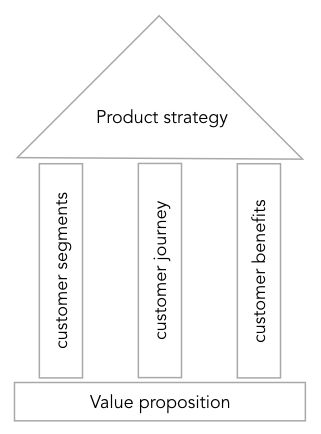
Value Proposition Value proposition of a product or a service explains how it solves customers’ problems or improves their existing situation. (We’ll just use the word “product” to mean both product and service henceforth.) It’s important to have a clear value proposition. How clear it needs to be? And what is meant by clarity? Let’s read on.
Product strategy needs 3 pillars on top of a sound value proposition: customer segmentation, customer journey, customer benefits.
Customer segmentation
Different customers buy the same product for different reasons and with different urgency. The price of a product may be same for all, but its value is different for different people. Customer segmentation is identifying the different types of customers out there and understanding why they are buying your product. A customer segment is a unique group of people who buy your product for a unique set of reasons. How much value each segment derives from your product or service depends on their situation. In my experience many entrepreneurs do not segment their customers well enough. Customer segments like men’s vs. women’s clothing, business v.s. individual buyers of personal development training, renters vs. buyers of houses etc, are not good segments. There is more need for uniqueness in each of them.
To give you my idea of what is a good customer segment let’s talk of AirBNB. AirBNB focussed on conference goers in San Francisco for their first set of customers. Here is a great story from their early days about their first customer. He was late to book accommodation for a large conference happening in San Francisco. All the hotels were booked (or going at expensive rates.) He was looking for simple and cheap place to stay. When he saw a listing on AirBNB, he was excited to stay with some “web designers” and get to know them. He booked it. There is a lot to learn from this story. The customer segment was large enough (I would assume at least 100,000+ per annum) unique (flexible about hotel like facilities and wants to meet new people) and currently underserved. This is a great example of a first customer segment to go after. I encourage you to look for a unique set of customers for whom your product or service can create tremendous value.
But segmentation is tricky business. Given that you have full control on how you segment your customers, you can end up with a very large number of segments for every product. Obviously, it is recommended that (at least at the early stage) you focus your efforts on one or two customer segments only. AirBNB success story is a great example.
It may help learn more about formal customer segmentation methods over the internet if you are not familiar with them.
Customer journey
Customer journey is the sequence of steps that your customer would take: with OR without your product. Ideally you would want to put both journeys side by side and be able to demonstrate clear value in using your product. This step needs to be done after segmentation because different segments may have different journeys; because they buy differently or for different reasons. It is important to acknowledge that customers will have multiple alternatives to your product. Charting relevant alternatives will provide you many insights. Especially on how to deal with competition.
When UBER launched its taxi booking app, it would did not allow users book cabs in advance. Even though UBER knew that a large number of people want to book taxis in advance! These customers need advance confirmation of service and a reliable service. They are probably are making an important trip: a business meeting or catching a flight. In spite of it’s might, UBER had still decided not to serve on them. Instead they were focusing on the unplanned bookings made by people when they can’t find other options. Below diagram shows 2 simple customer journeys side by side. Real life ones are more complex.
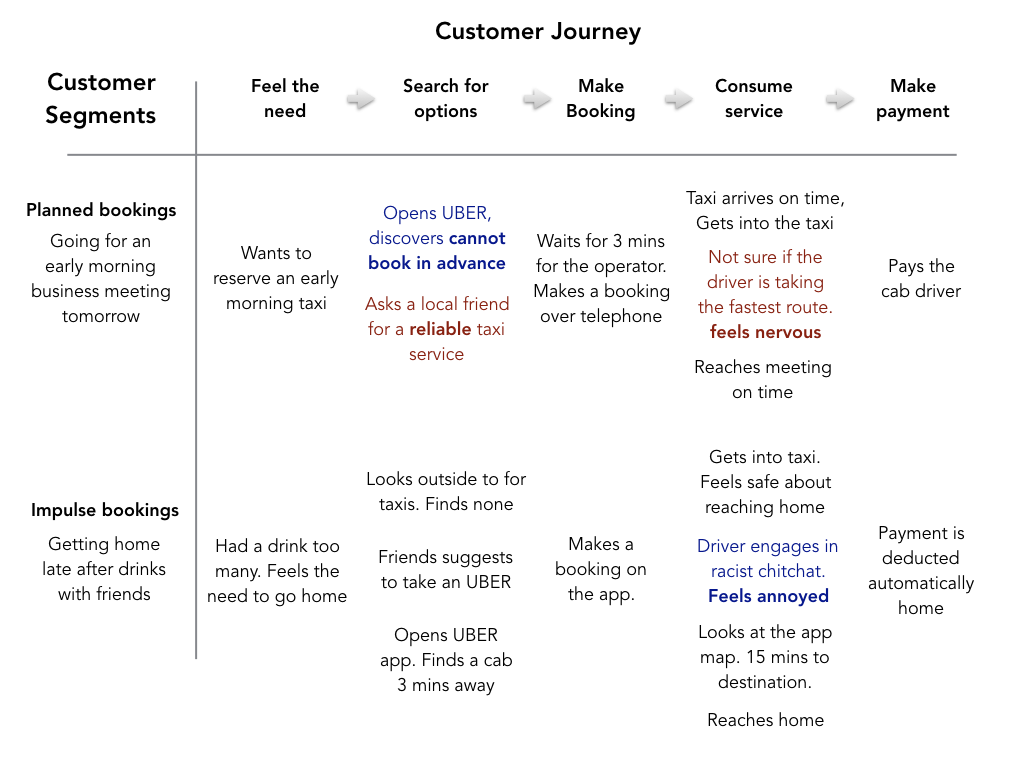
The blues and reds are areas of customer dissatisfaction for UBER and the local taxi company. Improvements here will make customers stick to you more. Ignoring them could increase customer churn. Customer journeys allow you to visualize customer touch points, look for areas of improvement and validate if the business idea is ever going to fly, given the alternatives the customer already has.
Customer benefits
This is step comes after the customer journeys because you need to go through the customer journeys to understand what value your product is creating for different customer segments at all interaction points. As much as possible I would encourage one to quantify customer benefits. Not because intangible benefits are of less valuable. But because intangibles benefits have tangible effects on business. With respect to an alternative, for example. Taking the case of Airbnb, having a friendly and amicable host is an intangible benefit for the lodger. But that intangible benefit could (say) double the chances of lodgers choosing Airbnb again: from 25% to 50%. Increase in preference makes the lodger experience more certainty. She spends less time searching and comparing other options, reducing her decision-making-time.
Reducing the number of customer’s decisions (and the time they spend researching them) is a great tangible benefit for any business. Uber makes it very easy for customers to determine cost of their next ride. If you input your destination, UBER will provide you an accurate estimate. That way it’s super easy for customers to make decisions. By providing an accurate estimate Uber is reducing customer decision time from a few minutes to a few seconds. No wonder Uber is known for it’s great customer experience.
Quantifying benefits will force you to think deeply about them. Not all benefits are quantifiable. Customer’s feelings of certainty, for example. But most benefits some have quantifiable effects.
Note: Most products have multiple types of users. Teacher and student, buyer and seller, developer and reviewer etc. While mapping customer benefits, it is important to examine benefits to each type of user separately. Each user type should derive significant value from the value proposition.
Conclusion
Finally, going back to your original question “How clear should the value proposition be?” I would say that your value proposition needs to be clear enough to support the above three exercises. Understanding your value proposition, customer segmentation, customer journey, customer benefits is a significant part of your product’s strategy. Thinking these things through will make your strategy sound and give you confidence face the future.
Question and comments? You can write to me an email.